

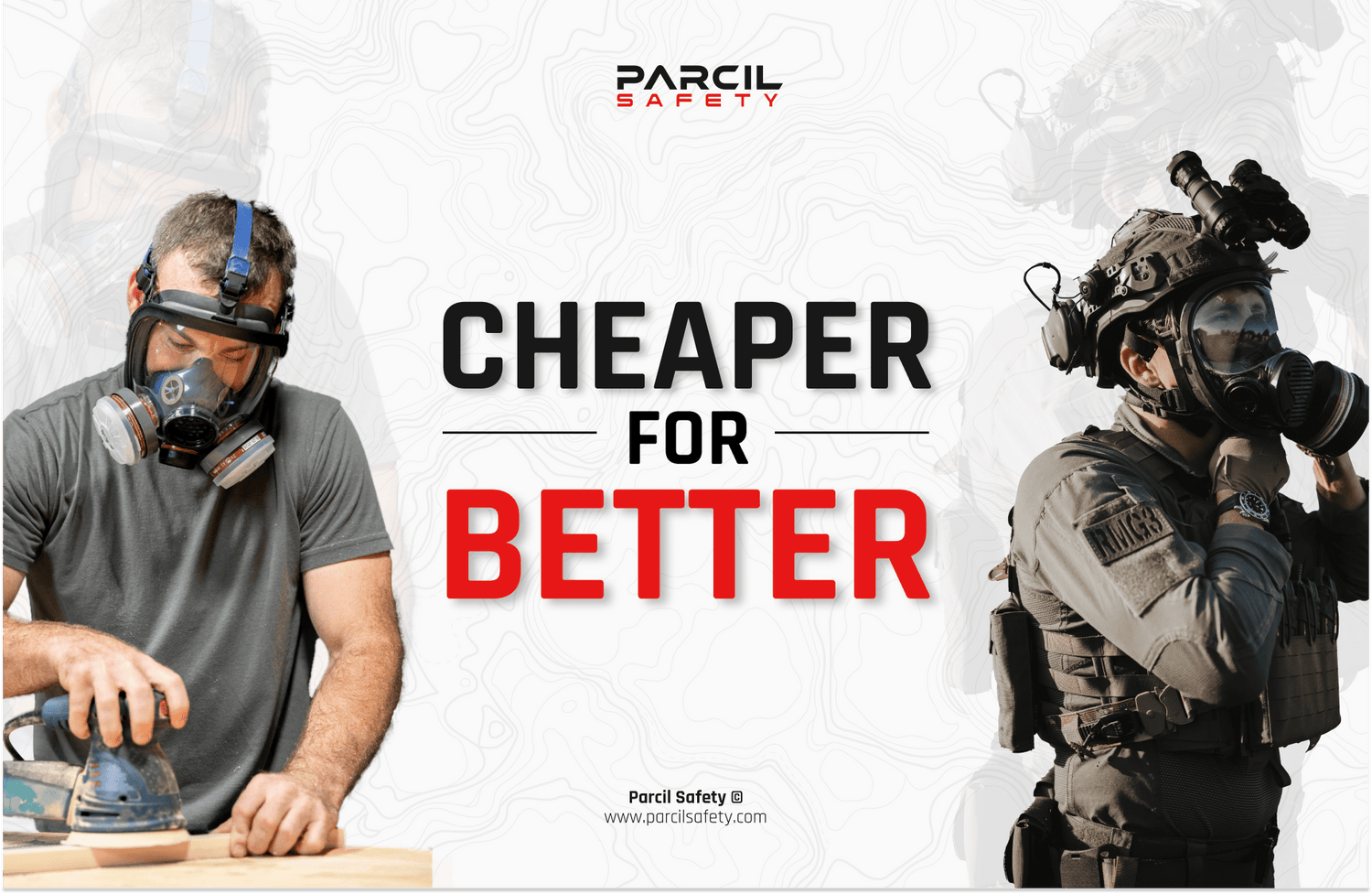
We're Cheaper. That's the Point.
Let's talk about the elephant in the room.
If you've compared respirator prices, you've probably noticed: Parcil Safety is less expensive than a lot of the competition. And if you're the kind of person who questions everything (which, if you're buying safety equipment, you should be), that might make you pause.
Good. Ask questions. Because when it comes to protection, cheap should never mean cutting corners.
So let's be direct about why our prices are lower, and why that's actually a good thing.
Price Isn't Proof of Protection
A higher price doesn't automatically mean better protection. And a lower price doesn't automatically mean worse. What matters is what's behind the price.
Testing. Certifications. Specifications. Materials. Performance.
That's where respirator protection should be judged. Not by how premium the packaging looks, how recognizable the brand is, or how many layers of markup stand between you and the product.
How We Keep Prices Lower (Without Cutting Corners)
We're not going to pretend we're doing something magical. Here's what's actually happening:
We work directly with manufacturing partners. No distributors taking a cut. No retail middlemen inflating the price. We source directly, which means the cost savings go straight to you instead of disappearing into someone else's margin.
We carefully select and spec every product. We don't just slap a label on whatever's cheapest. Every respirator in our lineup is evaluated against our own product standards for materials, construction, filtration performance, and fit. If it doesn't meet the bar, it doesn't get listed.
We maintain certifications and documented testing. Our products carry applicable certifications and are backed by real, documented testing. We don't ask you to take our word for it. We point you to the specs, standards, and test results.
We provide U.S.-based support. Questions about fit, filter compatibility, or shelf life? You're talking to real people in the U.S. who actually know these products, not a bot or an overseas call center.
We price aggressively on purpose. We don't believe safety equipment should carry a luxury markup. We'd rather sell more product at a fair price than less product at a premium one. The protection is the same. The only difference is what you're paying for it.
A Word About Shelf Life Claims
This one's worth calling out directly.
CBRN canisters (the filters that protect against chemical, biological, radiological, and nuclear threats) are tested and rated for a specific shelf life. That testing exists for a reason: it tells you how long the sealed filter maintains its protective integrity.
Our CBRN canisters carry a 10-year shelf life, which is the maximum that independent testing can reliably certify. That's not a marketing number. That's what the testing supports.
You may see competitors advertising 20-year shelf life claims on similar canisters. Here's the problem: even the manufacturers producing those filters have only tested them to 10 years. A 20-year claim without 20-year testing data isn't confidence. It's marketing.
When someone makes a claim about how long their product will protect you, ask to see the documentation. Ask for the test data. If it doesn't exist, the claim doesn't hold up, regardless of the price tag.
What You Should Actually Compare
Before you compare price tags, compare what's behind them.
1. Certifications & Testing
Look for applicable certifications, standards, and documented testing. These provide a much stronger basis for evaluating protection than price alone.
2. Filtration & Specifications
Know what the respirator and filters are actually rated to do. Compare filtration ratings, filter compatibility, protection classifications, and other relevant specifications.
3. Materials & Features
Construction matters. Look at the materials, fit, seal, lens, valves, straps, and other features that affect how the respirator performs and how it works for your application.
4. Then, Compare the Price
Once you know what you're getting, compare the cost. A lower price means more when the specifications, testing, and features hold up.
The Bottom Line
We focus on the things that actually matter: meeting applicable standards, using appropriate materials, and delivering protection backed by testing and certification.
Because when you're choosing respiratory protection, the price tag tells you what you're paying. The specifications tell you what you're getting.
The smartest purchase isn't necessarily the cheapest one. It's the one that gives you the protection and performance you actually need for the price you're willing to pay.
We just happen to think you shouldn't have to overpay for it.
— The Parcil Safety Team
Leave a comment
All comments are moderated before being published.
This site is protected by hCaptcha and the hCaptcha Privacy Policy and Terms of Service apply.